Many US engineering organizations are not choosing a country for the first time. They already run part of their delivery through a team in India, Eastern Europe, or Southeast Asia, and that setup has worked well for a while.
Then the roadmap changes. Product work gets more ambiguous, the architecture gets more interconnected, or the team starts shipping faster than an overnight feedback loop can support. Someone asks whether part of that work should move closer to the US workday, to a nearshore team.
That question is different from the one most country guides answer. Comparisons such as Mexico, India, or Eastern Europe? help a company choose a market.
CodersLink's decision framework helps it decide whether Mexico is worth evaluating at all. A company that already has an offshore team is making a transition decision: which work moves, in what order, and how ownership changes hands.
This guide covers that transition. It assumes the existing offshore team has real value, because in most cases it does. The goal is not to replace it, but to put each workstream where it operates best.
Signs an offshore setup has reached its limit for specific work
Offshore models rarely fail all at once. They usually stop fitting one type of work while continuing to serve others well. The signals tend to show up in the workflow before they show up in a budget review.
|
Signal
|
What it usually looks like
|
What it suggests
|
|
Overnight round trips
|
A question asked at 4 p.m. ET gets an answer the next morning, and the follow-up waits another day
|
The work depends on context that changes faster than the handoff cycle
|
|
Review latency
|
Pull requests sit for most of a day before anyone on the other side can review them
|
Code review has become a queue instead of a conversation
|
|
Decisions drifting to one side
|
Architecture and product decisions happen in US hours, then get relayed as instructions
|
The offshore team executes but no longer shapes the work
|
|
Meetings at the edges of the day
|
Someone is always joining at 7 a.m. or 9 p.m.
|
Synchronous needs are higher than the model was designed for
|
|
Slow ramp-up for new hires
|
New engineers wait for feedback across time zones during onboarding
|
Onboarding needs more live access than the current setup gives
|
|
Incidents spanning two working days
|
A production issue found late in the US day waits for the next overlap window
|
Response time depends on who happens to be awake
|
None of these signals means the offshore team is underperforming. Usually it means the work changed and the operating model did not. A team built for stable, well-specified delivery is now being asked to handle work that needs same-day decisions.
That distinction matters for the move. If the signals cluster around a few workstreams, the answer is to move those workstreams. If they show up everywhere, the problem may be the operating model itself, which a new geography will not fix.
What changes when work moves from offshore to nearshore Mexico
The biggest change is not cost or talent supply. It is how long context has to wait. When engineers share most of the US workday, a blocked task can be unblocked in the same afternoon instead of the next morning.
Research on distributed software teams has measured that waiting time for decades. A study of two multi-site engineering organizations published in IEEE Transactions on Software Engineering ourlines that work items spanning sites took about 2.5 times as long to complete as comparable same-site work. Engineers in the same study reported that delays waiting on a remote colleague averaged 2.4 days, compared with 0.9 days for a local one.
The mechanism matters as much as the number. A later laboratory experiment published in The Journal of Management Information Systems found that much of the effect of time-zone separation on team performance ran through communication: how often team members exchanged messages and how quickly they took turns. Overlap helps because it makes conversation possible, not because the clocks match.
That shift shows up in a few concrete places:
- Feedback loops shrink from days to hours. A question, a clarification, and a follow-up can all happen in one working session.
- Code review becomes conversational. Reviewers and authors are online together, so comments get resolved while the work is still fresh.
- Engineers join the decisions, not just the outcomes. Mexico-based engineers can attend architecture reviews, sprint planning, and product discussions during normal hours.
- Onboarding gets more live support. New engineers can reach managers and peers in real time during their first weeks, which is when that access matters most.
- Incidents get handled within one working day. A production issue found in the US afternoon can be worked on by people who are still online.
Why Mexico wins for same-day engineering work
One detail often gets missed in planning. Mexico eliminated daylight saving time in 2022, except for some municipalities along the US border. Mexico City now stays on Central Standard Time all year, so the gap with US teams shifts by an hour across seasons but the overlap never disappears.
Many markets have strong engineers. However, Mexico wins in this kind of work because it combines several things a transition needs at once: overlap with the full US workday, an engineering market deep enough to staff whole workstreams, short travel, and familiarity with how US companies operate.
- Overlap that covers the whole workday. Mexico City shares most of its working hours with every US time zone, all year. India Standard Time, by comparison, runs 9.5 to 10.5 hours ahead of US Eastern time, which leaves little shared time unless someone works very early or very late. That gap is what turns a same-day question into a multi-day wait.
- A market that can staff a workstream, not just a seat. Mexico has roughly 390,000 people employed as software developers, analysts, and multimedia professionals, according to the official data in CodersLink's Mexico Tech Talent Overview 2026. That depth matters when the plan is to move ownership of a system, not to add one contractor.
- In-person time that is practical. Quarterly planning, onboarding weeks, or a visit during a critical launch are easier to justify when the trip takes a few hours instead of a full day each way.
- Familiarity with US companies. Many Mexico-based engineers already work with US teams and practices, which tends to shorten the adjustment period. That still depends more on the individual than on the country, so it belongs in the interview process, not in assumptions.
This is where nearshoring to Mexico earns its place. It is not a cheaper version of offshore delivery; it is the right location for work that cannot wait overnight. For the broader business case, including costs and when Mexico is not the right fit, see CodersLink's analysis of whether nearshoring to Mexico is worth it.
What does not change: problems geography will not fix
Shared hours remove waiting time. They do not remove the reasons work was hard to hand off in the first place. Several problems travel with the work to any market:
- Unclear ownership. If nobody owns a service or a decision today, moving the work only moves the ambiguity to a new team.
- Thin documentation. An offshore team often relies on tribal knowledge built over years. That knowledge has to be captured before the move, not after.
- Manager capacity. New engineers need feedback, review, and direction. If managers are already stretched, adding a Mexico team moves the bottleneck from hiring into delivery.
- An unrealistic role profile. A requisition that combines a rare stack, narrow industry experience, and a tight budget stays hard to fill in any market. This is explored in what to do when the engineer you want barely exists.
- A weak operating model. Rituals, access, and decision rights have to be designed on purpose. As discussed in Global Hiring Needs an Operating Model, distance exposes process gaps that were easy to hide locally.
There is also a trap specific to this kind of move. If Mexico-based engineers get tickets but stay out of planning, architecture, and product discussions, the company pays for overlap it never uses. The result looks like offshore delivery with a closer time zone, and the expected gains never show up.
Which workstreams to move first
The right first move is the work where waiting costs the most. As published in Nearshore vs Offshore for Startups, the delivery model belongs to the workstream, not to the whole company. The same logic applies to a transition.
|
Workstream
|
Move priority
|
Why
|
|
New product initiatives still shaped by customer feedback
|
Move first
|
Requirements change daily, and every overnight delay slows discovery
|
|
Core platform and architecture work
|
Move first
|
Decisions involve several owners and benefit from live discussion
|
|
Customer-facing features with tight release cycles
|
Move early
|
Product, design, and engineering need to iterate together
|
|
Production support and incident response for US-hours systems
|
Move early
|
Response time depends on who is online when issues appear
|
|
Integrations with US partners or internal US teams
|
Evaluate case by case
|
Value depends on how often the work needs real-time coordination
|
|
Mature services with stable interfaces
|
Often keep offshore
|
Clear specs and good documentation make async delivery work well
|
|
Migrations, test automation, and well-defined backlog work
|
Often keep offshore
|
The work is separable and benefits less from shared hours
|
|
Follow-the-sun coverage
|
Keep offshore
|
Time-zone separation is the point of the setup
|
Two questions help with the cases in the middle. First, how many times a week does this work stall waiting for someone in another time zone? Second, how much of the work depends on decisions that are still being made? High answers to both point toward moving the work. Low answers suggest the current setup is doing its job.
Role matters as well. A move works best when the market can supply the specific profiles the workstream needs. Mexico Tech Talent by Role breaks down the market for full stack, AI, QA, and DevOps roles, and the Mexico Tech Salaries Report shows compensation by role, seniority, and English level.
Running an offshore-to-nearshore transition without breaking delivery
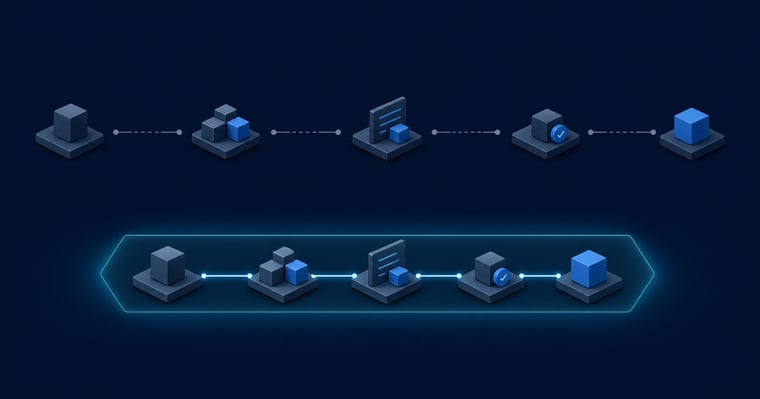
The riskiest version of this move is a hard cutover: one team stops and another starts. A planned overlap period costs more for a few weeks, but it protects delivery and keeps knowledge from disappearing. Most transitions work best in four phases, each with a clear exit condition.
- Prepare the work before you move it. Pick the first workstream, document its services, decisions, and known issues, and name a single owner for the handoff. Exit when a new engineer could understand the system from the documentation and one walkthrough.
- Hire and shadow. Mexico-based engineers join the workstream and pair with the current owners. They attend the same reviews and rituals but do not yet own releases. Exit when they can ship small changes with review from the current team.
- Reverse the shadow. Ownership moves to the Mexico team, while the offshore engineers stay available as reviewers and escalation points. This is where hidden knowledge usually surfaces. Exit when the new team handles a full release cycle and at least one production issue on its own.
- Settle the new split. The offshore team moves fully to the workstreams that suit asynchronous delivery. Both teams keep shared documentation, shared standards, and a clear map of who owns what.
The shadowing phases exist because handover documents rarely carry everything. In interviews with 27 developers and managers, McGill researcher Martin Robillard found that participants repeatedly struggled with lost tacit knowledge, the practical know-how behind a system, after a colleague moved on. Participants described handover sessions as useful in theory but very different from handling a real customer issue. The same study found that anticipating a departure plays a major role in preventing knowledge loss, and that an internal transfer to other work can erase knowledge as completely as someone leaving the company.
A few practices make the handoff smoother:
- Be direct with the offshore team about the plan. Engineers who expect to lose their work have little reason to share what they know. Engineers who know their next workstream usually help the transition succeed.
- Treat knowledge transfer as deliverable work. Give it time in the sprint, not just in spare hours.
- Move one workstream at a time. Each transition teaches the organization something that makes the next one faster.
- Decide the engagement model early. Whether the company hires directly, uses staff augmentation, or builds a dedicated hub affects how quickly the first phase can start. For most transitions, nearshore staff augmentation is the fastest way into the shadowing phase: Mexico-based engineers join the existing team, its tools, and its rituals without the company opening an entity in Mexico. Hiring Nearshore Developers in Mexico: What to Check First covers the checks to run before opening the search.
CodersLink's Staff Augmentation model is built to integrate Mexico-based engineers into existing teams, tools and rituals.
A portfolio, not a replacement
The most durable result of this kind of move is rarely "we left offshore." It is a portfolio: work that needs same-day context sits in Mexico, and work that runs well asynchronously stays where it already performs. Each model does what it does best.
That portfolio view also protects the company from a common overcorrection. Moving everything to Mexico can raise costs on work that never needed shared hours, and it can throw away years of system knowledge held by the offshore team. Keeping everything offshore can leave the most time-sensitive work stuck in overnight cycles.
A nearshore staff augmentation model also makes the split easier to adjust, because capacity can shift between workstreams as the roadmap changes. Cost belongs in the same view: salary is only one part of the business case, and a move that cuts delays on critical work can be worth it even when the hourly rate is higher.
The decision should be revisited as the roadmap changes. A product that was exploratory last year may now be mature enough to distribute. A stable service may suddenly need rapid changes because of a new customer or regulation. The question is not "Mexico or offshore?" but "where does each workstream operate best right now?"
For teams still comparing markets at a broader level, Best Countries to Hire Software Developers in 2026 and Nearshore vs Offshore: Which Model Fits US Tech Teams? cover that earlier stage of the decision.