Engineering velocity improves when teams share enough working hours to make decisions, unblock work, and keep feedback moving. Time-zone alignment means building engineering teams with enough shared working hours to collaborate in real time when the work needs quick context or decisions.
For software teams, those shared hours shape daily execution. They affect pull request reviews, product clarification, onboarding, manager support, and the speed at which small blockers get resolved.
Distributed teams can do meaningful work asynchronously. Documentation, recorded updates, written specs, and clear ownership help distributed engineering teams keep work moving across locations.
Engineering work also needs live collaboration for architecture decisions, sprint planning, incident response, onboarding, QA handoffs, product feedback, and technical troubleshooting. That turns time-zone overlap into an operating decision for engineering leaders.
How many shared hours does the team need? Which workflows need same-day decisions? Which roles need live access to managers, product owners, or senior engineers?
For U.S. companies comparing nearshore time zone software development options, these questions help narrow the right hiring destination before the first candidate enters the process.
CodersLink covers this issue in its guide to hiring nearshore developers in Mexico: role scope, collaboration model, onboarding, and manager load all need to be clear before hiring begins.
Is software delivery built on feedback?
A developer opens a pull request. A senior engineer reviews the code. A product manager clarifies expected behavior. QA flags an edge case. A designer answers an implementation detail. A manager removes a blocker. The team adjusts before the issue grows.
When those loops move quickly, delivery feels coordinated. When they slow down, work piles up between handoffs.
Time-zone alignment protects the moments when feedback needs to be live, or close to live. The real impact comes from accumulated delay between questions, answers, reviews, approvals, and decisions.
Mature engineering teams plan for some delay. Strong async teams use documentation, issue threads, recorded walkthroughs, and written decision logs to reduce meeting dependency.
Every engineering organization also has workflows where next-day answers slow delivery. A production issue needs escalation. A new engineer needs help understanding the codebase. A technical decision needs alignment between product and engineering. A candidate in the interview process needs fast feedback before another company moves first.
Those are the moments where overlap becomes operational leverage.
Async work still needs shared working hours
Async work gives distributed teams more focus, flexibility, and documentation. It also gives people more room to contribute across locations without turning every update into a meeting.
GitLab’s asynchronous communication guide describes async work as a system built on documentation, intentional communication, context, and ownership transfer. That guidance is useful because it treats async as an operating practice with clear expectations.
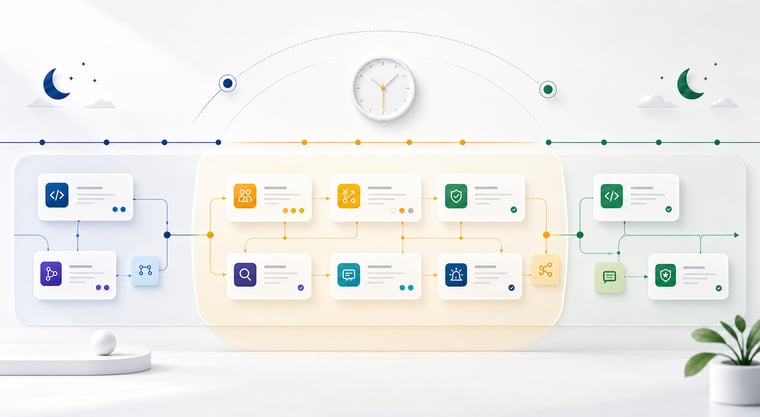
The practical question for engineering leaders is how to design the right rhythm between async and live collaboration. Async works well for status updates, written specs, documentation, code review comments, and decision records, while live overlap helps with high-context work: incidents, architecture tradeoffs, onboarding, manager coaching, design reviews, sprint planning, and product clarification.
When teams share enough working hours, async work becomes a strength. Documentation carries the routine context. Overlap protects the work that needs quick alignment.
Time-zone gaps create hidden management cost
The cost of time-zone distance often shows up in the manager’s calendar before it shows up in a project report.
A manager starts taking early calls with one region and late calls with another. Senior engineers shift their schedules to answer questions. Product owners leave clarifications across multiple tools. Feedback gets fragmented.
The team keeps moving, and the coordination load grows.
Harvard Business School Working Knowledge reported research on more than 12,000 employees at a multinational company and found that synchronous communication declined by 11 percent when the time delay between workers increased by one hour. The same article notes that software engineers were more likely to shift work into early mornings or evenings to preserve real-time collaboration.
That is the hidden cost. The work moves forward, and someone absorbs the friction.
Sometimes it is the engineering manager. Sometimes it is the senior developer who becomes the bridge between teams. Sometimes it is the product lead who has to repeat context across regions.
Over time, the team may protect delivery by stretching the people responsible for coordination.
Microsoft’s Work Trend Index points to a related collaboration pattern: meetings after 8 p.m. are up 16% year over year, driven by cross-time-zone collaboration, and 30% of meetings now span multiple time zones.
For engineering leaders, the question is direct: how much coordination can the team absorb before velocity turns into calendar debt?
Overlap improves onboarding and ramp time
Time-zone alignment matters early in the employee journey, especially during onboarding.
A new engineer needs documentation, context, and fast access to the team. They need to understand how the team reviews code, makes decisions, defines quality, handles incidents, adjusts product requirements, and shares help.
Strong documentation helps. In the first 30 days, new hires also need fast feedback.
They need quick PR reviews, access to senior engineers, live team rituals, and manager support before blockers grow. They also need a reasonable working schedule that lets them participate in the team’s real rhythm.
When the team has meaningful overlap, onboarding becomes more visible. Managers can coach earlier. Peers can explain context faster. Technical blockers are easier to spot.
The new engineer joins the team’s rhythm faster.
This is one reason nearshore software development works well for many U.S. engineering teams. The value is access to talent inside a collaboration model that fits the team’s existing operating cadence.
CodersLink’s remote tech team solutions are structured around different capacity needs, including Staff Augmentation, MESHubs, and Nearshore RPO.
Product feedback moves faster with aligned teams
Engineering velocity depends on product, design, QA, and stakeholder decisions. Product feedback, customer requirements, design changes, and priority calls all affect how quickly software moves from idea to release.
Across distant time zones, a small product question can slow a full delivery loop. A developer pauses to clarify expected behavior. A product manager answers hours later. QA finds a scenario that needs a decision.
The release moves forward, but the loop stretches; aligned working hours keep those loops moving.
Product and engineering can clarify tradeoffs in the same day. Designers can answer implementation questions before a handoff stalls. QA can surface defects while the developer still has the context fresh. Managers can make priority calls before uncertainty spreads across the sprint.
This is where the nearshore vs offshore decision becomes operational. Teams comparing markets should evaluate total operating cost, delivery visibility, manager load, and handoff delay alongside nominal hourly rates. A company can hire strong engineers in many markets. The better question is: which market lets those engineers participate in the team’s actual delivery rhythm?
How much overlap does a team need?
The right amount of overlap depends on the work.
A support-heavy engineering team may need more real-time coverage for escalations. A platform team may need shared hours for architecture decisions and incident response. A product squad may need daily overlap with product managers and designers.
A mature async team may need fewer meetings, while still protecting reliable windows for complex work.
Engineering leaders can start with five questions:
- Which workflows require same-day decisions?
- Which roles need regular access to managers or senior engineers?
- How quickly do code reviews need to happen to protect delivery speed?
- How much onboarding support does the team need in the first 30 days?
- Which rituals need shared working time?
The goal is a clear set of core collaboration windows.
A healthy model protects the work that benefits most from live communication: sprint planning, architecture review, incident response, onboarding, product clarification, team rituals, and manager support.
Where Mexico fits for U.S. engineering teams
Mexico can be a strong market for U.S. companies because it supports real-time collaboration while expanding access to engineering talent.
This is where the nearshore advantage becomes practical.
Time-zone proximity helps U.S. teams integrate developers into existing rituals, code review cycles, sprint planning, product discussions, and manager check-ins.
CodersLink’s guide to nearshore software development in Mexico frames the country as a growth strategy for U.S. companies because proximity supports faster collaboration and a clearer operating rhythm.
For engineering leaders, the strategic value is straightforward: the team can add capacity while keeping its core collaboration habits intact.
Location works best when the operating model is ready. Teams also need role calibration, onboarding structure, documentation, manager readiness, and clear ownership.
For budget and seniority planning, the CodersLink's Tech Salaries Report 2026 gives employers a Mexico-specific compensation benchmark by role and seniority.
A Mexico-based engineering team can join standups, participate in planning, receive same-day feedback, and stay close to product and engineering leadership.
That makes time-zone alignment part of the operating model from the beginning.
Checklist before choosing a global hiring market
Before choosing a global hiring market, engineering leaders can define how the team needs to work.
Use this checklist to evaluate a distributed engineering team model:
- Define the core collaboration hours for the team.
- Identify which ceremonies need live participation.
- Set expectations for code review turnaround.
- Clarify which roles require daily or weekly manager access.
- Map product and customer feedback loops that need same-day response.
- Plan how new engineers will get help during their first 30 days.
- Separate async work from live collaboration needs.
- Identify coordination needs that could create after-hours work for managers.
- Decide how the team will measure whether overlap is improving velocity.
This kind of planning makes global hiring more predictable. It helps the company choose a market that fits the way the team delivers work.