
In a nutshell
Hiring a senior AI or engineering professional from abroad usually starts with one question: will they get an H-1B? For Mexican and Canadian professionals, there is a second answer. The TN visa has no cap, no lottery and no annual filing window, and TN visa requirements are clear once you know what consular officers look for.
This guide covers what US employers need to know: which tech roles qualify, what you and your new hire have to provide, how the process works, what it costs, how long it takes and why cases get denied. It draws on the webinar Beyond the H-1B Lottery, where Arielle Sheinfeld (immigration attorney and co-counsel to Manifest Law), Tony Le (Head of Talent at Ceribell) and Jesús "Tito" Salas (Founder and CEO of CodersLink) walked through how employers use TN in practice.
What is a TN visa?
The TN visa is a US work status for Canadian and Mexican citizens who work in professions listed under the United States-Mexico-Canada Agreement (USMCA). It was created in 1994 under NAFTA and carried over when USMCA replaced it, which is why you will still see it called the NAFTA visa.
Five features define it:
- No cap and no lottery. You can hire one TN professional or fifty, at any time of year.
- Up to three years at a time. It can be renewed in three-year periods while the role continues.
- One employer, one role. The TN covers the job described in the application, for the US employer that offered it.
- Temporary intent. TN is a nonimmigrant status, so the professional has to plan to leave when the job ends.
- Family can come. Spouses and children under 21 join in TD status.
One difference matters when you hire from Mexico. Canadian citizens can request TN status at the border, while Mexican citizens first need a TN visa from a US embassy or consulate.
TN visa vs. H-1B: why a lottery can't carry a hiring plan
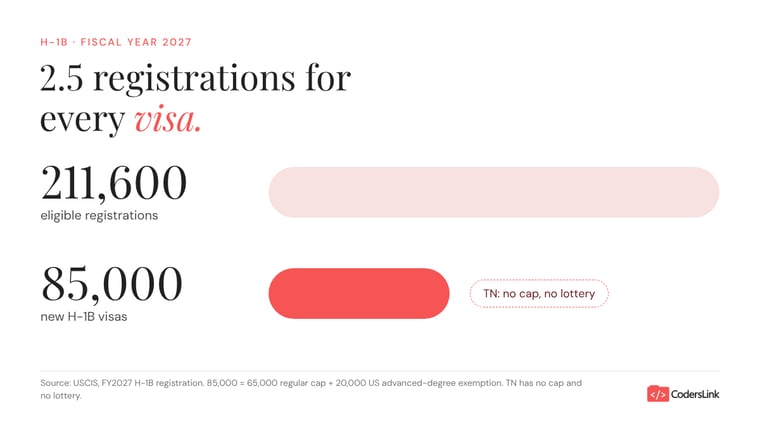
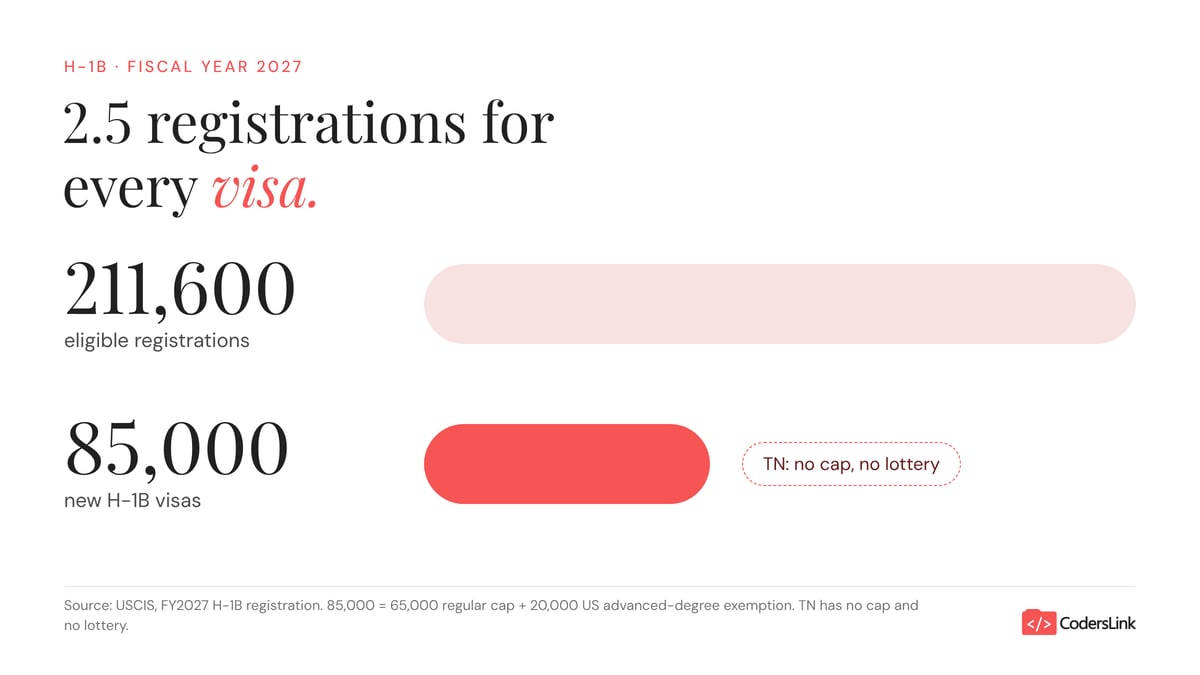
The H-1B is the work visa most employers know, and it runs on a once-a-year lottery. For fiscal year 2027, USCIS received about 211,600 eligible registrations for 85,000 new H-1B visas: 65,000 under the regular cap and 20,000 for holders of US advanced degrees. That is roughly 2.5 registrations for every visa.
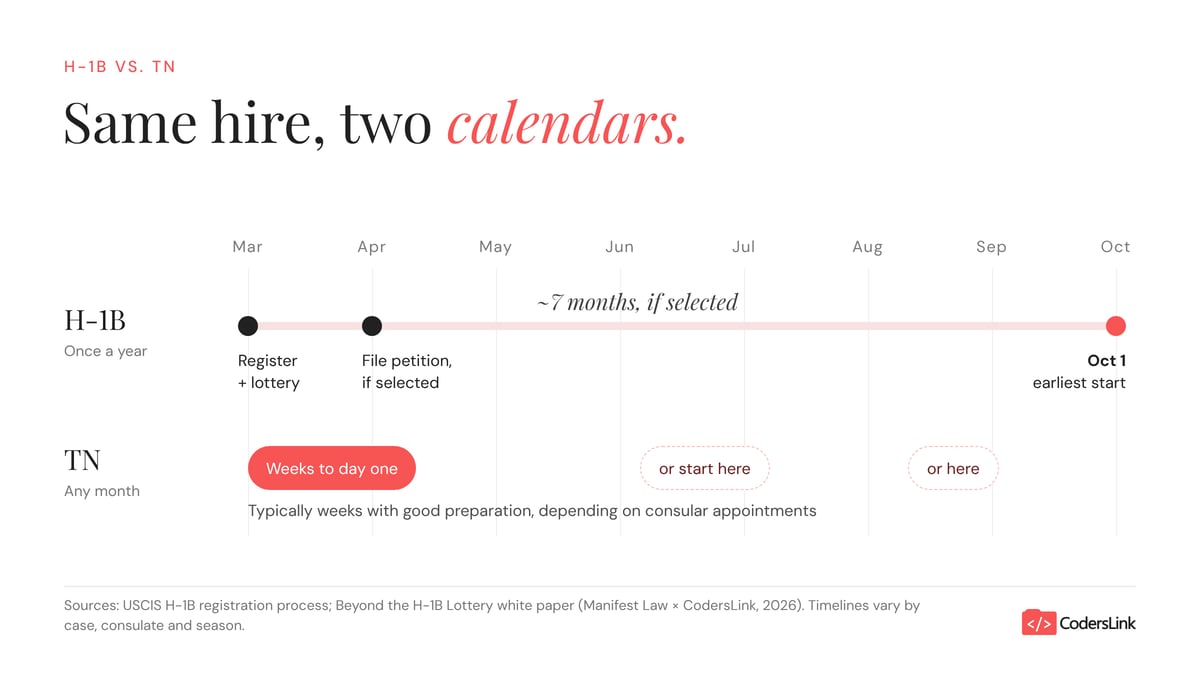
Timing is the other constraint. H-1B registration opens once a year in March, selected employers file petitions from April 1, and the earliest start date is October 1. From registration to day one, that is about seven months, and only if your registration is selected. Costs are uncertain too: a $100,000 payment on certain new H-1B petitions, introduced by proclamation in 2025, was blocked by federal courts in 2026 and is still in litigation as of November 2026.
TN works on a different logic:
| H-1B | TN | |
|---|---|---|
| Who it's for | Specialty occupations, any nationality | Mexican and Canadian citizens in listed USMCA professions |
| Annual cap | 85,000, allocated by lottery | None |
| When you can apply | Once a year (March registration) | Any time |
| Earliest start | October 1, if selected | As soon as approved |
| Length of stay | Up to 6 years in total | Up to 3 years at a time, renewable |
| Typical time to start | 6 to 9 months | Weeks, with good preparation |
TN is not a replacement for the H-1B. It is a second, predictable path for roles you can fill with Mexican or Canadian professionals. Tony Le made the same point from the talent side: start from the skills the business needs and where the work happens, then choose the visa path, not the other way around.
Does the TN visa require sponsorship?
Not in the H-1B sense. There is no lottery registration, and when a Mexican professional applies at a consulate, the employer does not file a petition with USCIS first. But a TN always needs a US employer. The professional cannot be self-employed, and the USCIS Policy Manual, updated in 2025, clarifies that the employer has to be a US entity.
In practice, the employer's part is to:
- Make a job offer in a role that fits a TN profession.
- Provide a support letter that describes the role, the TN category, the duties, the term and the pay.
- Keep the professional working within the role the TN describes.
Arielle Sheinfeld put it plainly in the webinar: many employers hear the word "sponsorship" and run the other way, but TN is far simpler than its reputation. Most of the work is designing the role and the letter correctly.
TN visa requirements: what the employer and the professional need
What the employer provides
- A signed offer letter for a role in a TN profession, with a defined term of up to three years.
- A support letter, usually prepared with immigration counsel. It is the core of the case: it confirms the offer, names the TN category, lists professional-level duties, states the term and compensation, and connects the professional's degree to the role. Arielle recommends adding a detailed duties chart and mapping it to the Department of Labor description for that occupation.
- Company information that shows the employer and the offer are real.
- No permanent-job language. TN requires temporary intent, and wording that offers a permanent role can get the application rejected.
What the professional needs
- Mexican citizenship and a valid passport, ideally valid for more than six months.
- A degree related to the role. For Mexican professionals, that means both the título and the cédula profesional. Finishing classes is not enough, so check both at screening, before the offer.
- Transcripts and a résumé that show the education and experience the category requires.
- The ability to explain the job consistently at the consular interview.
- Temporary intent: a plan to leave the US when the job ends.
TN professions list for tech roles
The USMCA professions list includes about 60 occupations. Four of them cover most tech hiring:
| Role | Supports TN | Weakens TN |
|---|---|---|
| Software or AI/ML engineer | Designs and builds ML systems and the services around them | Writes code to spec |
| QA lead | Designs the test strategy and automation framework | Runs manual test cases |
| Solutions architect | Analyzes client requirements and designs the system architecture | Supports sales demos and closes deals |
| Data scientist | Builds statistical models to forecast demand | Pulls reports and updates dashboards |
| AI strategy consultant | Advises on AI strategy for a defined six-month project | Joins the team as ongoing staff |
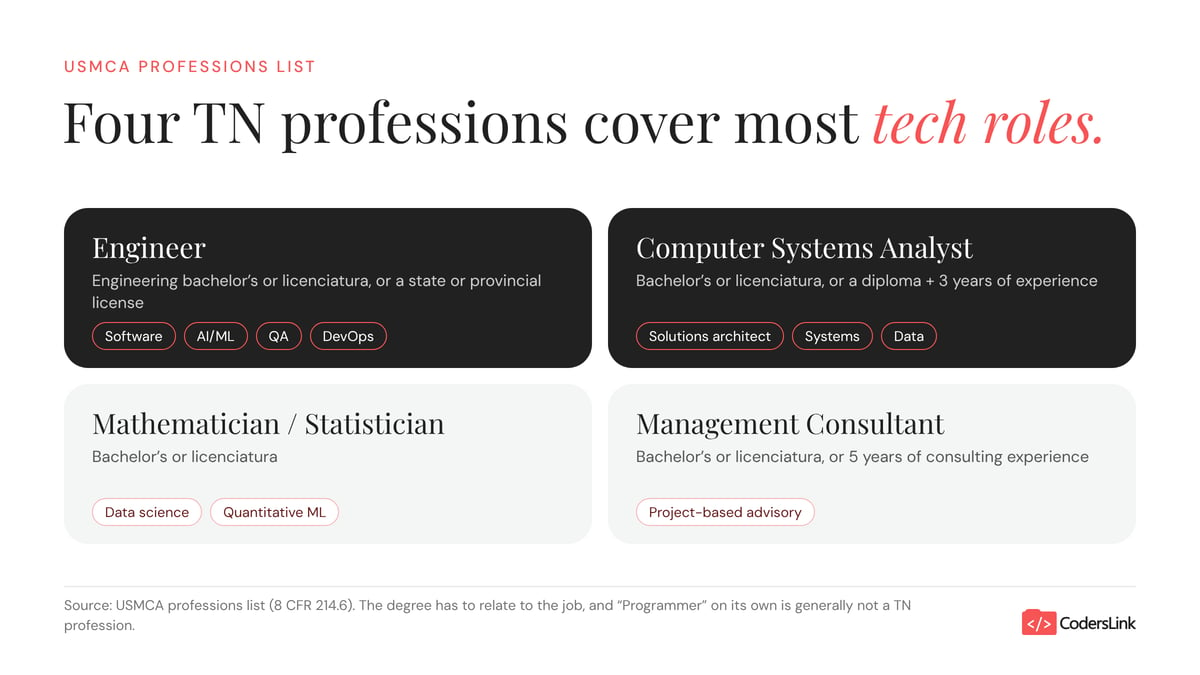
Two rules decide most cases:
- The degree has to match the job. An Engineer role needs an engineering degree, not just engineering experience. USCIS narrowed its guidance for engineers in 2025, with more weight on degree relevance and on how well the duties fit the profession.
- The title sets the stage. Officers weigh the duties more than the title, but a title that doesn't match the category raises a red flag for the rest of the application. "Programmer" on its own is generally not a TN profession.
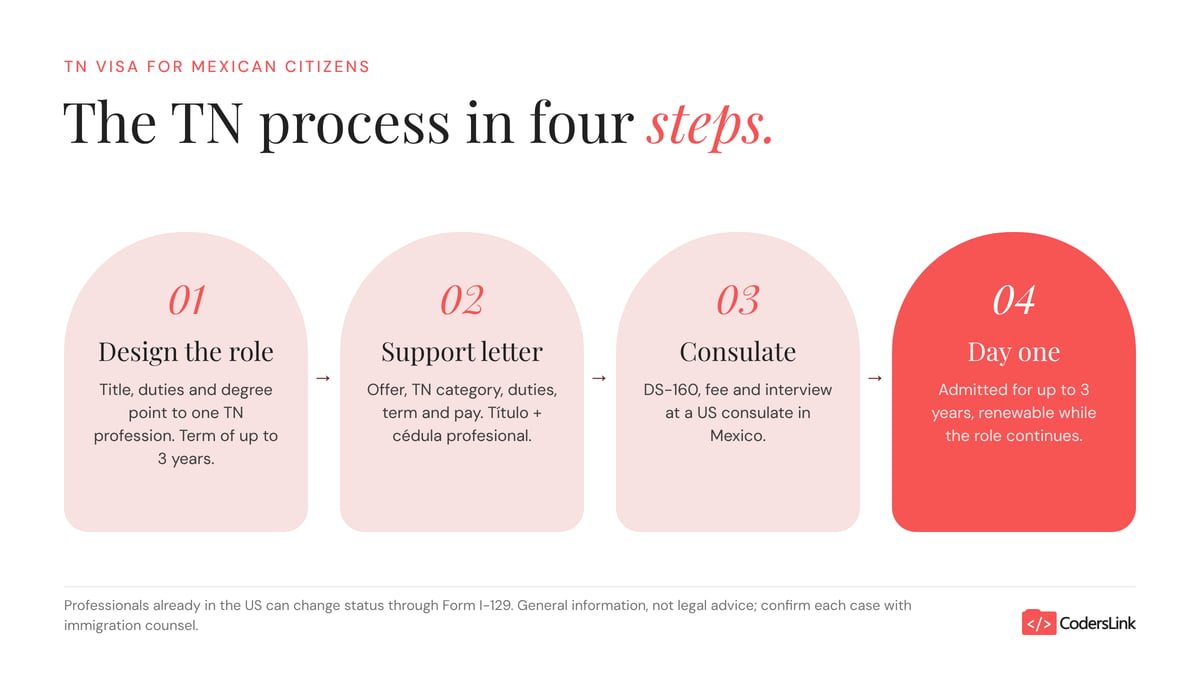
How the TN visa process works, step by step
Step 1: Design the role and the offer. Assess the job, not the person. The role has to fall clearly within one TN profession, and the title, duties and degree have to line up. Describe the work in professional-level terms such as design, analysis, architecture and modeling, avoid routine execution, and set a defined term of up to three years.
Step 2: Prepare the support letter and documents. The employer and counsel prepare the support letter and the signed offer letter. The professional gathers the título and cédula profesional, transcripts, résumé and a valid passport. Add basic company information.
Step 3: Apply and interview at a US consulate. Mexican citizens complete the online DS-160 application, pay the fee and book an interview at a US consulate in Mexico. At the interview, the professional presents the TN package and answers questions about the job. Consistency between the answers and the support letter matters most: Arielle has seen professionals asked to recite their duties out loud or to write some of them down. She recommends a preparation session between counsel and the professional before the interview.
Step 4: Admission and day one. With the TN visa approved, the professional is admitted at the border or airport for up to three years. Work is limited to the sponsoring employer and the role described.
Consular processing or a USCIS petition?
Consular processing is the most common route for new hires from Mexico. If the professional is already in the US in another status, the employer can file Form I-129 with USCIS to change or extend status. Even then, any trip abroad requires a valid TN visa stamp to return.
Get the full TN playbook
The Beyond the H-1B Lottery white paper covers qualifying roles, the support letter, Mexico's talent market and a week-by-week hiring calendar.
How long does a TN visa take, and what does it cost?
With a well-prepared case, a TN visa typically takes weeks, not months. The biggest variable is consular appointment availability, which changes by consulate and season.
The government fee is small. The State Department charges a $185 application fee per person for TN and TD visas; check its fee page for any issuance fee that applies. For an employer, the larger costs are usually:
- Immigration counsel to design the role and draft the support letter.
- Relocation support, if you offer it.
- US market pay. A relocated TN professional works in the US at US market rates, so the case for TN is speed and certainty, not salary savings.
If the professional is already in the US and you file Form I-129, USCIS filing fees apply. Manifest Law keeps a detailed breakdown in its guide to TN visa costs.
Job description wording that helps or hurts a TN case
Because the officer evaluates the job, the wording of the duties carries a lot of weight. The same role can read as a TN profession or as routine work:
| Role | Supports TN | Weakens TN |
|---|---|---|
| Software or AI/ML engineer | Designs and builds ML systems and the services around them | Writes code to spec |
| QA lead | Designs the test strategy and automation framework | Runs manual test cases |
| Solutions architect | Analyzes client requirements and designs the system architecture | Supports sales demos and closes deals |
| Data scientist | Builds statistical models to forecast demand | Pulls reports and updates dashboards |
| AI strategy consultant | Advises on AI strategy for a defined six-month project | Joins the team as ongoing staff |
Why TN applications get denied
Most denials come from TN visa requirements that weren't checked early enough:
- The title and the duties don't match.
- The support letter is vague.
- The degree is in an unrelated field.
- The título or cédula profesional is missing.
- The interview answers don't match the support letter.
- The offer describes the job as permanent.
Good preparation solves almost all of them. Check the role and the credentials before the offer, not after.
After approval: renewals, job changes, family and green cards
- Renewals. TN is renewed in three-year periods, through Form I-129 or a new consular application, with no set limit while the work stays temporary.
- Changing employers. A new employer needs a new TN before the professional starts.
- Family. Spouses and children under 21 can join in TD status. They can study, but they cannot work.
- Green cards. TN requires nonimmigrant intent when the professional applies and enters the US. Plans change, and many TN professionals later become permanent residents, but timing needs careful planning with counsel. Arielle does not recommend applying for or entering on a TN while an I-140 is pending or approved.
A worked example: one SaaS company, six roles, two paths
Acme Analytics is a fictional 450-person B2B SaaS company in Austin that is adding AI features. It entered four people into the H-1B lottery and one was selected, while key roles stayed open for five months. The deciding question for each role is whether the work needs physical presence in the US:
| Role | On site? | Path | Likely TN profession |
|---|---|---|---|
| 2 × AI/ML engineer | No | Remote in Mexico | Engineer, if relocated later (degree has to match) |
| QA lead | No | Remote in Mexico | Engineer or Computer Systems Analyst (duties beyond manual testing) |
| Technical support lead | No | Remote in Mexico | Case by case; help desk roles usually don't qualify |
| Solutions architect (client-facing) | Yes | TN relocation | Computer Systems Analyst (design and analysis, not sales) |
| AI strategy consultant (6-month project) | Partly | TN or remote | Management Consultant |
Only one of the six roles needs a visa on day one. The rest can start remotely while the TN case for the on-site role moves forward.
Where TN fits in a Mexico hiring plan
Tito Salas described the model in two stages:
- Hire and test remotely in Mexico. Engineers work from Mexico in US time zones, with seven to eight business hours of US-timezone overlap. Hiring takes three to four weeks from intake, followed by a three to six month pilot with clear performance criteria. This is how Staff Augmentation works with CodersLink.
- Relocate proven engineers with TN. For the roles that need to be on site with teams or customers, immigration counsel such as Manifest Law handles the TN case. CodersLink does not provide immigration services.
The talent is closer than most hiring plans assume. Nine of the ten leading tech employers in India also build engineering teams in Mexico. Mexico has 283 nonstop routes to the US, more than any other country, and Monterrey is an hour and twenty minutes from Austin. Among engineers in the CodersLink Tech Salaries Report 2026, 81% work in English at B2 or higher. And for remote roles, senior employer cost in Mexico runs 35% to 65% of US loaded cost, before service fees.
CodersLink has spent eleven years in Mexico, with 1,050+ engineers placed and 150+ client companies. If you are mapping which roles to hire remotely and which to relocate, our guide to hiring in Mexico and our time zones guide are good next reads.
Watch the webinar on demand
Manifest Law, Ceribell and CodersLink walk through TN eligibility, the consular interview and where to hire in Mexico.
This article is general information, not legal advice. Immigration rules and fees change often, so confirm the details of any case with an immigration attorney and the official USCIS and State Department sources linked above. Last reviewed November 2026.
Sources: USCIS: TN USMCA Professionals · US Department of State: Visas for Canadian and Mexican USMCA professional workers · US Department of State: Fees for visa services · USCIS Policy Manual, Volume 2, Part P · 8 CFR 214.6 · USCIS: H-1B electronic registration · Beyond the H-1B Lottery white paper
Key takeaways