
In a nutshell
What is the difference between staff augmentation, managed services and outsourcing?
Staff augmentation adds engineers to your team who take direction from your managers; you own the outcome. Managed services hands a defined function, such as support or platform operations, to a provider who runs it against a service-level agreement. Project outsourcing hands a bounded deliverable to a provider who owns delivery, scope and the team.
The three words get used loosely, and a lot of the confusion in this category comes from vendors describing one model with the vocabulary of another. The cleanest test is to ask who is accountable for what on a Tuesday afternoon.
- Staff augmentation. An engineer joins your squad, attends your standup, works in your repo and takes priorities from your engineering manager. The vendor is accountable for finding, replacing and retaining the person; you are accountable for what the person builds. This is what CodersLink sells as Staff Augmentation, and what most LATAM staffing firms sell under names like "dedicated developers" or "nearshore teams".
- Managed services. You hand over a function, not a person: an L2 support desk, cloud operations, a QA practice, a data platform's day-to-day. The provider staffs it, runs it and reports against an SLA (tickets closed, uptime, mean time to restore). You do not manage the individuals. Softtek's IT managed services offer is the archetype in the Mexico market; Globant, EPAM and Endava sell the same shape at global scale.
- Project outsourcing. A scoped deliverable, a statement of work, a price and a date. The provider owns the team, the method and the risk of hitting the date. Once it ships, the team moves on. BairesDev, Wizeline and the enterprise firms above all sell this; so do thousands of smaller agencies.
There is a fourth thing that is not a model at all: consulting, which is advice and design without delivery accountability. It sits upstream of all three and we leave it out of the matrix.
Control, outcome and risk, model by model
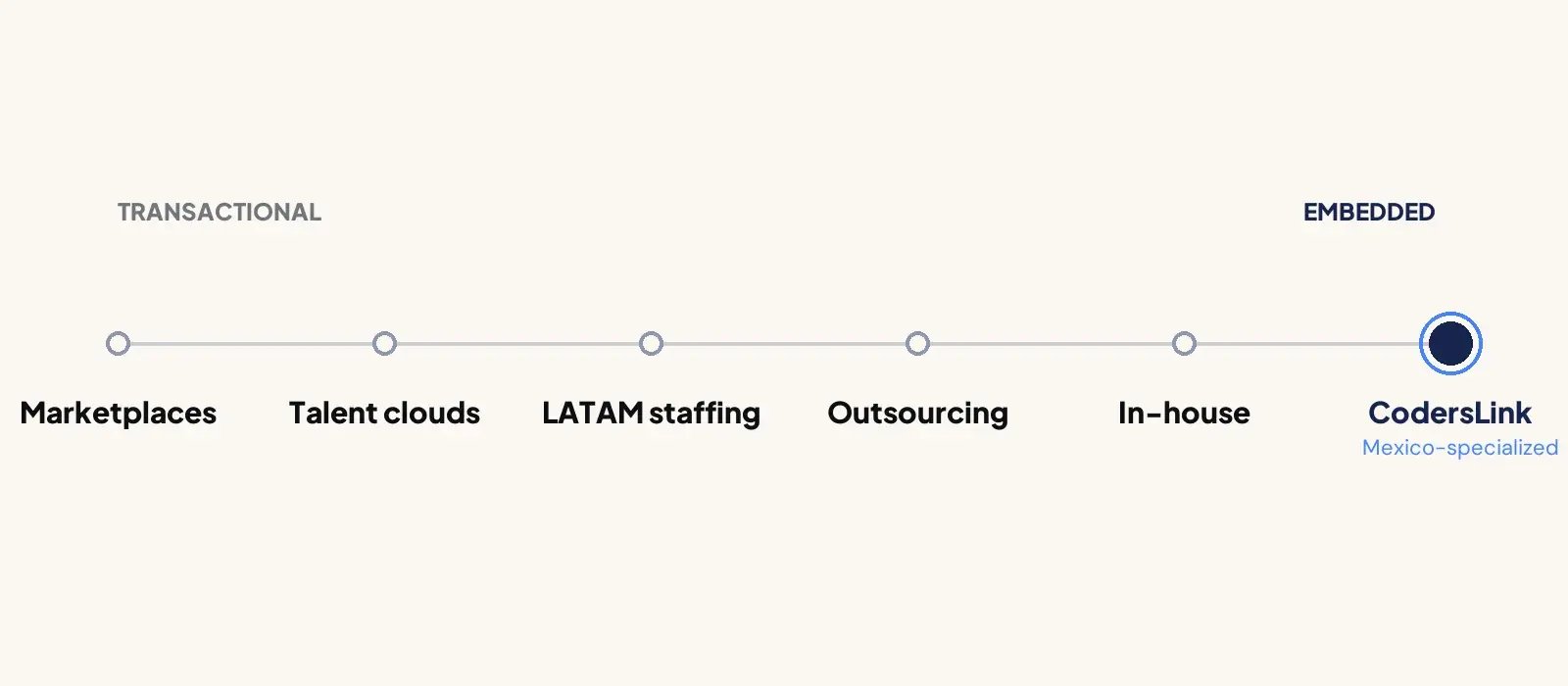
In staff augmentation you manage daily work and own the outcome; the vendor carries recruiting and replacement risk. In managed services the provider manages the work and owns the SLA; you carry the risk of the SLA being the wrong measure. In outsourcing the provider manages and owns delivery; you carry the risk of scope drift and knowledge leaving with the team.
Put the three side by side and the trade-offs stop being abstract.
| Variable | Staff augmentation | Managed services | Project outsourcing |
|---|---|---|---|
| Who manages daily work | Your engineering managers | The provider's delivery manager | The provider's project manager |
| Who owns the outcome | You | Shared: provider owns the SLA, you own whether the SLA was the right target | The provider, against the SOW |
| Unit of purchase | An engineer-month | A service level (tickets, uptime, throughput) | A deliverable |
| Cost driver | Seniority, stack, volume, term | Scope of the function and SLA tightness | Scope, estimate accuracy, change requests |
| What the vendor is paid to do | Find, vet, replace and retain the person | Run the function within the SLA | Ship the deliverable on the date |
| Key risk you carry | Your management capacity; a weak manager wastes a strong engineer | Measuring the wrong thing; the function drifts from the product | Scope drift; knowledge leaves with the team at handover |
| Key risk the vendor carries | Attrition, mis-hire, replacement cost | SLA penalties, staffing the function | Estimate error, fixed-price overrun |
| Knowledge retention | Stays in your team as long as the engineer stays | Stays with the provider; documented at the interface | Leaves at handover unless bought back |
| Typical minimum commitment | Lowest in the stack; monthly is common | Multi-year contract is the norm | Per project |
| Best when | You have engineering leadership and a roadmap that outlasts a project | The function is stable, measurable and not your differentiator | The work is bounded, specifiable and separable from your core codebase |
Two things in that table decide most cases. The first is management capacity. Staff augmentation only works if you have engineering managers with room to lead more people; if you do not, the model quietly becomes outsourcing without the accountability, and it fails. The second is whether the work is your product. Outsourcing and managed services are excellent for things you need done well but do not need to own: a payroll integration, a support tier, a migration. They are a poor fit for the codebase that is the company, because that is where knowledge retention and continuity matter most, and both models are designed to move the team on.
What each model costs, and what moves the number
Staff augmentation is priced per engineer per month and driven by seniority; managed services is priced per service level and driven by scope; outsourcing is priced per deliverable and driven by estimate accuracy. CodersLink Staff Augmentation starts from $6,500 (mid-level), $7,500 (senior) and $10,500 (staff+) per engineer per month, all-in.
On cost, the three models are not directly comparable, because they buy different things. A per-engineer rate buys time and attention; an SLA buys an outcome band; a fixed price buys a deliverable and the vendor's estimating risk. What you can compare is the shape of the bill and what makes it move.
- Staff augmentation bills a fixed monthly rate per engineer. At CodersLink that rate starts from $6,500 for a mid-level engineer, $7,500 for a senior and $10,500 for staff-plus profiles, per engineer per month, all-in by role family. The number moves with seniority, stack scarcity, volume and term. Inside it is the engineer's compensation, the engineer-care package (private major medical with dental and vision, paid time off, paid Mexican holidays, a home-office allowance, an end-of-engagement bonus) and our sourcing and retention work. We never take a cut of the engineer's pay. Clients report savings of 30 to 57% versus comparable US hiring; the basis is the fully loaded US cost for the same seniority.
- Managed services bills against the function. Most providers do not publish rates; Softtek, for instance, markets outcomes such as a 30% reduction in operation costs through managed services rather than a price (softtek.com, as read September 2026). Expect a multi-year term, a transition fee and a change-control process for anything outside the SLA.
- Project outsourcing bills per deliverable, either fixed price or time-and-materials with a cap. BairesDev publishes a 30 to 50% savings band against US rates on some pages and no rate card (bairesdev.com, September 2026). The number that matters is not the quote but the change-request rate on the project after it.
Where the models converge in cost is at the hub end. When an augmented team passes roughly fifteen engineers, consolidating recruiting, payroll and operations into one structure gets cheaper per seat. That is what MESHubs does: a build-operate-transfer hub priced as a markup, standard 15% and as low as 12% on expansions of ten or more full-time engineers, plus a transfer fee when the team moves onto your entity.
IP and security under each model
All three can protect IP if the contract does; the difference is who signs and under which law. In staff augmentation you need a present assignment of IP from the vendor and, through it, from each engineer. In managed services and outsourcing the provider typically owns the work until acceptance, so the assignment clause and the escrow terms matter more.
Security and IP are where buyers most often compare the wrong thing. A vendor's certification tells you how the vendor runs its own environment; it says little about the code an engineer writes inside your repo under your access controls. In staff augmentation the engineer works in your environment, so your controls apply and the residual question is legal: who owns what the engineer produces, and is that ownership enforceable where the engineer lives.
For a Mexico-based team the phrase to avoid in the contract is the US term "work for hire", which does not carry over cleanly into Mexican contractor law. What works is a present assignment of IP, worldwide and perpetual, written into the engagement contract and flowed down to each engineer. That is how CodersLink contracts, and it is one of the six diligence questions our comparison hub suggests you ask every vendor.
In managed services and project outsourcing the provider usually owns the work product until you accept and pay for it, and reuses its own accelerators and frameworks across clients. That is normal and efficient; it just means you should read the background-IP and licence-back clauses, and ask what happens to the code if the relationship ends mid-project. Two vendors we read in September 2026, Unosquare and ParallelStaff, publish security certifications on their sites; CodersLink holds none it can state, and if a certification is a procurement requirement that is a real criterion against us.
Fit by company stage
Early-stage teams should use outsourcing or a marketplace for bounded work and add staff augmentation once a role becomes durable. Growth-stage teams (50 to 1,000 people) are the natural fit for staff augmentation and a hub. Enterprises should use managed services and large outsourcers for breadth and reserve staff augmentation for a specific division.
| Stage | What you need | Right model | Staff augmentation fit |
|---|---|---|---|
| Early stage (pre-seed to Series A, 5 to 50 people) | Specialist gaps filled fast, optionality, minimal overhead | Marketplaces or a small outsourcer for project work; staff augmentation once the role is durable | Often premature |
| Growth stage (Series A to C, 50 to 1,000 people) | Predictable capacity, onboarding consistency, a real team, a management layer that scales | Staff augmentation as the entry point; a hub at scale | Strongest alignment |
| Enterprise (1,000+) | Governance, procurement compatibility, multi-region programmes | Managed services and large outsourcers for breadth; a hub for a Mexico-specific division | Selective |
The growth-stage band is where the published CodersLink case studies sit. Particle built a 19-role team in under 120 days and held 97% retention at twelve months. Q2 integrated 57 technology professionals in under nine months. NetProtect started with six people in Guadalajara and grew to forty over eighteen months before taking the team onto its own payroll, which is the hub model completing its transfer.
The enterprise band is where we most often recommend someone else. If you are procuring a multi-year, multi-country transformation with a 200-engineer statement of work, Softtek, Globant or EPAM are built for it and we are not; the CodersLink vs Softtek page says so in more detail.
When does a hybrid make sense?
Hybrids work when each model is used for what it is good at: staff augmentation for the core product team, outsourcing for a bounded module with a clear interface, managed services for a stable function you do not need to own. The failure mode is using one model for everything because the procurement was easier.
Three patterns come up repeatedly in the teams we work with.
- Augment the core, outsource the edge. The product team is augmented with dedicated engineers who stay; a bounded piece with a stable interface (a data-migration, a legacy connector, a marketing site) goes to an outsourcer on a fixed price. The interface is the contract.
- Staff augmentation that graduates into a hub. Most CodersLink engagements start with one or a few augmented engineers, cross a stable threshold, and become a MESHub with recruiting, payroll, benefits and governance consolidated, and a transfer path onto your entity. Same standard, same partner, no re-sourcing.
- Managed services for the function, augmentation for the product. Support, NOC or platform operations under an SLA with a managed-service provider; product engineering augmented. The two rarely conflict as long as the escalation path between them is written down.
What does not work is managed staff augmentation as a euphemism: a vendor supplies people, keeps them on its own project manager's priorities, and calls it a team. You get the coordination overhead of outsourcing with the accountability gap of augmentation. If a vendor cannot tell you plainly who the engineer reports to on a Tuesday, ask again.
Three things that change when the team is in Mexico
Three things change: who holds the engineer's contract and carries the classification decision, how much of the working day overlaps with yours, and how far you are from the team. In CodersLink Staff Augmentation and MESHubs the contract is with CodersLink in Mexico, overlap is seven to eight hours with US time zones, and the flight is two to four hours.
The model choice above is geography-neutral. The Mexico overlay adds three questions that a US-onshore comparison never has to ask.
Who employs whom. In Staff Augmentation, MESHubs and EOR the engineer's contract is with CodersLink, not with you, and the classification decision under Mexican law is ours to make and ours to carry. In Nearshore RPO and Direct Hire you employ, by design. Vendors in every model should be able to answer this in one sentence; many do not. The full per-model table is in our post on staff augmentation vs EOR vs PEO vs direct hire in Mexico.
Overlap. Central Mexico has been on UTC-6 year-round since October 2022, when the Ley de los Husos Horarios abolished daylight saving (Diario Oficial de la Federación, 28 Oct 2022), so only the US side of the window moves. That yields seven to eight hours of shared working time with US time zones, which is why staff augmentation, the model most dependent on live collaboration, works from Mexico in a way it does not from a nine-hour offset. The comparison is worked through in nearshore vs offshore staff augmentation.
Distance and cost. Nonstop flights from Dallas to Monterrey run about 1 h 50 and to Guadalajara about 2 h 40 (published schedules, September 2026), which makes quarterly onsite sprints routine. On cost, the Mexico Tech Salaries Report 2026 gives you the compensation curves behind any rate you are quoted: 10,246 verified respondents across 36 roles and 32 states, a median of MXN 55,000 net per month, and engineers with C2 English earning 2.03 times those at B1.
Deciding in three questions
Answer three questions in order. Is this work your product or adjacent to it? Do you have managers with capacity to lead more engineers? Will you want the same people on it in eighteen months? Product, capacity and continuity point to staff augmentation; a stable non-core function points to managed services; a bounded deliverable points to outsourcing.
- Is the work your product? If yes, keep management and knowledge in-house, which means staff augmentation or your own hiring. If no, the other two models are cheaper to run and you should use them.
- Do you have management capacity? Staff augmentation multiplies good managers and exposes missing ones. If you cannot name the person who will run the engineer's one-on-ones, choose managed services or outsourcing, or hire the manager first.
- Do you want continuity? If losing the same engineer in six months would hurt, you are building a team, not staffing a project. Buy from a vendor whose replacement and retention terms are written down: on CodersLink Staff Augmentation replacement is unlimited and free for the life of the engagement, and sourcing restarts within one business day.
- Then, and only then, compare vendors. The comparison hub lays the vendor categories out by criterion, and the vendor pages (for example CodersLink vs BairesDev for the outsourcing trade-off, or CodersLink vs Toptal for the marketplace one) show each vendor's own published terms.
If you get to the end of the three questions and the answer is managed services or a fixed-price project, we will tell you so on a call and name the firms we would look at. Book a 30-minute fit call and bring the roadmap.
Key takeaways