
In a nutshell
Outsourcing has become increasingly popular over the last decade as companies grow and their needs start to get so specific, that supply for particular positions, is not easily found in the national market. Moreover, with the rise of the startup ecosystem, outsourcing has provided a way for founders and entrepreneurs to find international top tech talent at a considerable discount to create their companies or enhance their existing team.
The term outsourcing is very much obscured and usually wrapped in a negative connotation, as it has been closely related to a flight of jobs away from the US into foreign companies.
“The main negative effect of outsourcing is that it increases US unemployment. The 14 million outsourced jobs are almost double the 7.5 million unemployed Americans.” as mentioned by Kimberly Amadeo from the Balance.
“It’s become synonymous with corporate irresponsibility, but outsourcing also offers jobs and community programmes [sic],” as argued by Paul Klein from the Guardian.
Regardless, before we can start objecting to it, we need to understand what it is, how to use it, and why it exists.
What is outsourcing?
Put in simple words, the definition of outsourcing is the practice of obtaining goods and services from a foreign supplier. This practice is most commonly used in industries where there’s either a shortage of labor for particular positions or where the cost of labor is too high. For example, software developers or designers, as it reveals the Tech Salaries Report.
Outsourcing is the practice of obtaining goods and services from a foreign supplier.
Companies can outsource any position whatsoever. Still, today, we see companies using it for non-fundamental roles, those whose function is to provide support to the central infrastructure of the company or aid in the day-to-day operations of the company.
Here are the predominant job sectors that companies outsource since 2015:
- Manufacturing
- IT Services
- R&D
- Distribution
- Call Centers
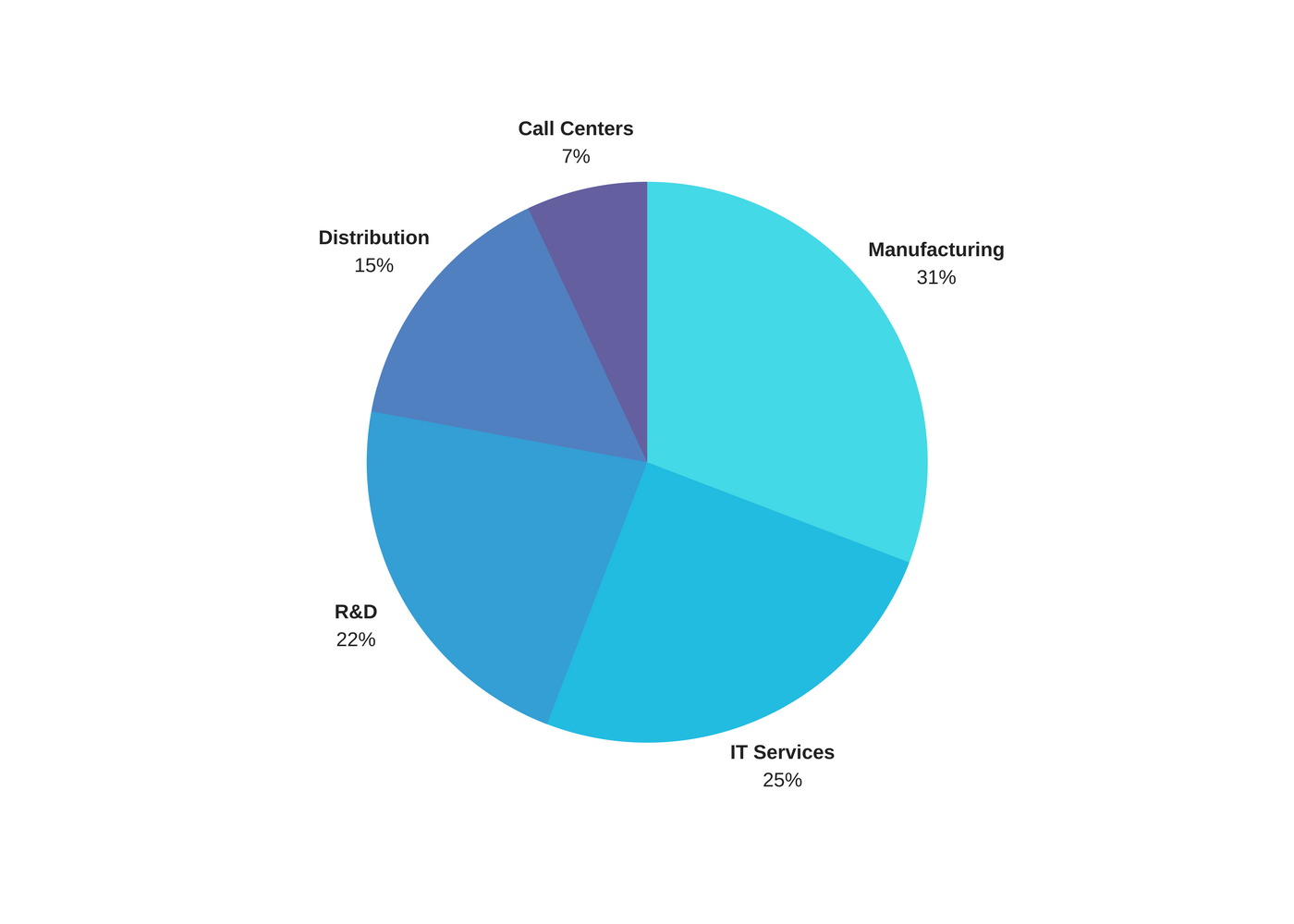
Via: Statistic Brain
With the rise of the technology sector and the startup ecosystem, outsourcing has become a window of opportunity for companies to acquire and retain development talent and teams as the supply of developers is not enough to meet the demand. Per Economics 101, given this deficit in supply, prices are considerably high for outstanding developers in the USA, making it prohibitive for some companies.
Why do companies outsource?
The simplest way to put it is that companies outsource because it reduces their overhead to produce a product, thus increasing their profit margins. It’s purely a business decision.
We live in a world where the same amount of work done in one country or city isn’t equally paid as if it were done elsewhere. Some can argue that the discrepancies in pay levels come from state and federal taxes, the country’s economic standpoint (measured in GDP per capita), and wage-setting institutions. Regardless, the basis of the decision is an economic one.
According to Brandon Gaille, 46% of companies have cited their top reason for outsourcing was to reduce operating costs, with 12% desiring to access world-class capabilities.
Here is a thorough breakdown of the reasons as to why people outsource:
1. Reduce or control costs — 44%
2. Gain access to IT resources unavailable internally — 34%
3. Free up internal resources — 31%
4. Improve business or customer focus — 28%
5. Accelerate company reorganization/transformation — 22%
6. Accelerate project — 15%
7. Gain access to management expertise unavailable internally — 15%
8. Reduce time to market — 9%
How does outsourcing work?
To answer this question thoroughly, we would have to dive deep into each of the different market segments where outsourcing is possible; our forte is in technology; thus, we will be answering this question from a technological standpoint.
Software developers and IT professionals are more often than not, hired through a recruiting agency, or an agency as it makes it easier and faster for companies to find the person with the qualities and experience they are looking for. Staffing agencies deal with all the sourcing, and the companies cherry-pick those they like.
Once the agency finds qualified professionals for the company, new workers can be placed in a particular office space, which usually requires extra work for the company or HR executive — or left to work remotely by their means.
Companies that outsource technology, quickly learn that these remote developers and tech professionals are results-oriented and rely heavily on milestones and deliverables.
In conclusion, outsourcing and co-sourcing can be a successful strategy for any company’s profit margins, and for productivity purposes, it comes with both its benefits and drawbacks, which we’ll explore in our next piece!
PS: If you want to download the ebook where we reveal how tech salaries in the US are compared to Mexico, you can download it for free.
Originally published at Medium
Key takeaways