- Kotlin
- Swift
- GraphQL
- CI/CD
- Public repo
- Reference report
- App Store shipping record
Nearshore RPO for teams whose hiring volume outpaces recruiting capacity
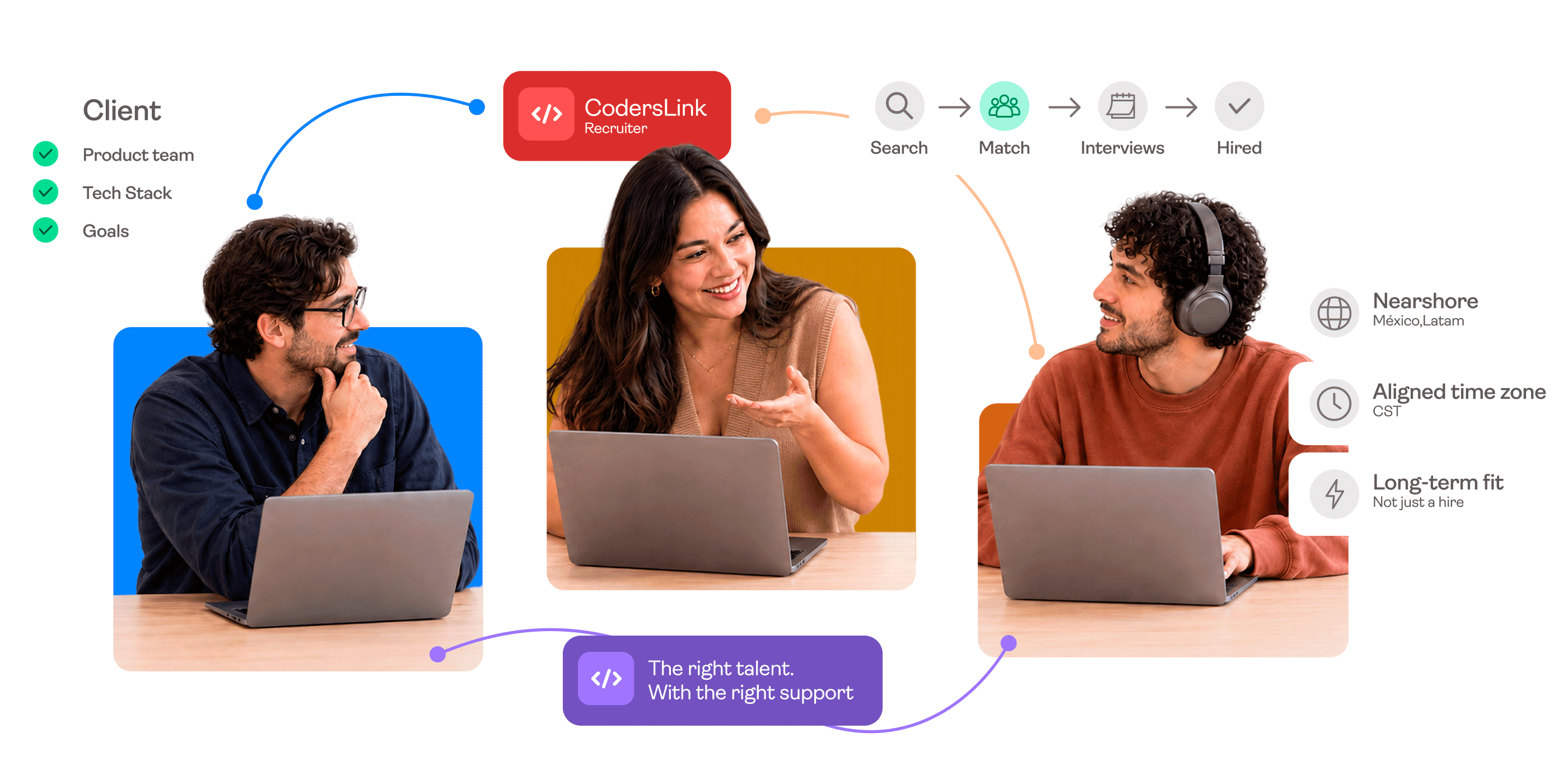
When requisitions stack up faster than your team can source, hiring slows down, managers lose time and agency fees become harder to justify. CodersLink embeds dedicated senior tech recruiters in your process, under your brand, backed by a 45,000-engineer community in Mexico you do not have to build from zero.
The first batch of vetted candidates reaches you within five business days per role, with multiple roles running in parallel. Every offer is backed by salary data from the Mexico Tech Salaries Report. Every hire is yours: you employ the talent, CodersLink runs the recruiting engine.
Trusted by engineering teams at
45,000 engineers in the community, inside a total Mexico pool of more than 750,000. The pipeline is built by hand: our recruiters approach engineers at their current companies, on GitHub and in Mexican technical communities. When your roles open, the sourcing has a decade of head start.
Dedicated recruiters embed in your hiring process and work under your brand and your employer-branding voice, with a delivery manager accountable for throughput. Candidates experience your company, not a vendor.
When senior reqs run for months, engineering managers lose a large share of their week to hiring loops while the roadmap slips. RPO absorbs the loop: sourcing, screening and coordination happen before your managers see anyone, so they only spend time on candidates above the threshold. Salary data helps calibrate offers earlier and reduce avoidable negotiation friction.
Every candidate arrives rated against the 75-point gate and the criteria you set at calibration, with an overall match percentage. Only candidates clearing the threshold reach your inbox.
Structured reference checks and background verification run before submission, and the findings are shared with you.
Each offer is grounded in the Mexico Tech Salaries Report, so you pay the market, not the guesswork.
Weekly written pipeline reports, with standing check-ins and monthly partnership reviews. You always know where every role stands.
Mexico runs on Central Time and has not observed daylight saving since 2022, so your overlap with US Eastern, Central and Pacific — seven to eight hours a day — does not move twice a year.
Illustrative examples of the profile format. Real profiles carry the engineer name, full history and the complete scorecard.
Weeks 0 to 2
≤5 business days per role
Weeks 2 to 5
Quarterly
Role criteria, volume targets and feedback on candidates as they arrive.
Sourcing, screening and curated shortlists per role, recalibrated as feedback comes in.
Your availability, interview rounds and final selection.
Interview coordination, feedback collection, offer support and salary guidance.
The offer letter, the employment contract and day one as your employee.
Pre-onboarding support, documentation and background verification.
The hires. Workload, priorities, performance and growth sit with you, as with any employee.
The recruiting engine: pipeline operation, recruiter management and weekly reporting.
Approving targets, invoices and any change in volume or scope.
One consolidated monthly invoice, written capacity changes and engagement wind-down under agreed notice terms.
| CodersLink Nearshore RPO | In-house recruiting team | Contingency agency | |
|---|---|---|---|
| Time to first candidates | First batch within five business days per role, with roles running in parallel |
Weeks to ramp sourcing, role by role |
Days to weeks, per search |
| Who runs the vetting | Five layers and a 75-point gate, identical on every role, then your criteria |
Your team, role by role |
Varies by recruiter and search |
| Pipeline depth | A 45,000-engineer community inside a 750,000+ Mexico pool, built over eleven years |
Built from zero, req by req |
Re-sourced for every search |
| Salary intelligence | A benchmark from the Mexico Tech Salaries Report on every offer |
Internal guesswork or purchased data |
Fees are often tied to salary, so buyers should compare incentives carefully |
| Who employs the hire | You. Every hire joins your payroll and your team |
You |
You |
| Cost structure | Embedded recruiter capacity, agreed in writing before you start |
Fixed headcount, whether reqs are open or not |
A fee per hire, on every hire |
| Replacement | A 90-day replacement warranty on every hire, and the pipeline restarts from the existing calibration |
You re-run the search |
Varies, often limited |
| Flexibility | Scale recruiter capacity up or down with thirty days’ notice |
Hiring and layoffs of your own recruiting team |
None between searches |
| Reporting | Weekly written pipeline reports, daily standups, monthly partnership review |
Internal |
Opaque between submittals |
| Path to scale | Staff Augmentation or MESHubs, same standard, no new search |
A new function to build each time |
A new fee each time |
Pinterest, the leading visual discovery engine, partnered with CodersLink to lead the complete expansion of its engineering team in Mexico: 22 senior engineers across Mobile, Full-stack and QA. A dedicated team of CodersLink recruiters worked full-time under the management of the Pinterest team for twelve months and fulfilled the project — every hire under Pinterest's brand and onto Pinterest's own payroll.
Nearshore recruitment process outsourcing (RPO) outsources part or all of your engineering recruiting to a partner in a nearby country, at volume. Dedicated recruiters embed in your process and work under your brand, backed by a pipeline and salary data they bring with them. You employ every hire: the product is a running recruiting engine, not contractors.
With CodersLink the pipeline is concentrated in Mexico, which puts every candidate inside US business hours. It is the right shape when hiring is continuous rather than occasional, and it sits in a stack that also includes engineers embedded one role at a time and dedicated hubs.
You do. That is the service. In Nearshore RPO, offer letters go out under your name, and every engineer joins your payroll, your benefits and your team as your employee. CodersLink runs the recruiting: sourcing, vetting, interview coordination, offer support and reporting.
This is the structural difference from Staff Augmentation, where the engineer contracts with CodersLink in Mexico and you direct the work. If you want the hires on your books, RPO. If you want the employment layer handled for you, Staff Augmentation.
The first batch of vetted candidates reaches you within five business days per role, with multiple roles running in parallel and roughly six qualified candidates per week, per pipeline. From job activation to a signed offer averages about 21 days, then one to two weeks to day one once the hire works their notice. Scarce roles run longer, and we tell you where your roles sit at calibration rather than after.
The same gate, on every role. Each candidate clears five layers: communication, soft skills, a live technical screen, background verification and references, scored against a 75-point threshold rather than a preference. The gate is identical whether you open one role or twenty, which is the proof that volume does not lower the bar.
Within that, every candidate is scored against the criteria you define at calibration, and only those clearing the role-fit threshold reach your inbox. Profiles arrive as scorecards in batches of three, with verified references and public work where it exists.
A monthly cost per dedicated recruiter, plus a success fee on each hire, put in writing before you start. Rates are set per engagement because they depend on volume, seniority mix and term: no opaque line items, and no change mid-engagement without your approval.
Budgets are grounded in CodersLink’s Mexico Tech Salaries Report, free and ungated, using current role and market data instead of guesswork: the same dataset our offer benchmarks are built on. We never take a cut of the engineer’s pay: our fee is agreed with you and is never deducted from what the engineer earns.
Every hire carries replacement coverage, with terms defined in the engagement agreement. If an engineer leaves or is not the right fit inside the covered window, we re-run the search, and the pipeline restarts from the existing calibration rather than from zero.
Worth stating the contrast plainly, because vendors describe this loosely: in Staff Augmentation the monthly rate is what keeps the seat filled, so replacements run for the life of the contract. In RPO the hire is your employee, so the coverage applies to the search.
Structure and incentives. A staffing or contingency agency is paid a fee per hire, usually a percentage of salary, which means its revenue grows when your offers do. RPO embeds a dedicated team inside your process on agreed capacity, with a benchmark from the Mexico Tech Salaries Report on every offer: the incentive is throughput and accuracy, not offer inflation.
You also keep the process: your brand, your ATS, your candidate experience, with weekly written reporting instead of silence between submittals.
Who employs the talent, and what you are buying. Staff Augmentation delivers engineers who contract with CodersLink and embed in your team: you buy capacity. Nearshore RPO delivers a recruiting engine: you buy throughput, and you employ every hire. The vetting standard, the community and the salary data are the same in both.
If you are hiring one or two roles, start with Staff Augmentation. If reqs are continuous, eight or more roles a year, RPO is the shape that scales.
Eight or more engineering roles a year is the design point. Below that, the fixed capacity of a dedicated engine outweighs the throughput you need: start with Staff Augmentation, and step up when hiring becomes continuous. Above it, the economics flip: dedicated capacity beats paying a fee on every single hire, and quarterly volume targets replace req-by-req scrambling.
1,050+ roles filled across 150+ companies over eleven years, with recruiting engines run for Pinterest, Udemy, DB Schenker and S&P Global.
You will find twelve public reviews, and the gap is worth explaining rather than glossing: in RPO we work as an extension of a client’s own recruiting team, under their brand and their employer-branding voice, so a company whose engineers believe they were hired by an internal team has a good reason not to publish a vendor review. We respect that, and it costs us review volume. What we can do instead is put you on the phone with a client. Ask on the first call and we will arrange it.
We do, inside your process. A delivery manager owns throughput and recruiter performance, runs the daily standups with your team and signs the weekly pipeline report. Your hiring managers own the criteria, the interviews and every hiring decision. You get the output of a recruiting function without managing one.
The engine scales down with thirty days’ notice, and you can step across to Staff Augmentation inside the relationship rather than restarting from zero. When volume comes back, the calibration, the criteria and the pipeline history are already in place: the engine restarts, not the search.
What you own on day one. In RPO you employ every hire from the start: we run recruiting throughput, and the hires land on your payroll, which assumes you can employ in the country where they sit. MESHubs is for when you want the team in Mexico without the infrastructure: CodersLink builds and operates a dedicated hub, handling payroll, benefits, HR and compliance at the team level, with a clear transfer path when you are ready to own it.
Same pipeline, same vetting gate. RPO buys throughput into your own structure; MESHubs buys the structure and the team together.
Bring three numbers and one structural point. The numbers: your average days per req today, the share of engineering-manager time going to hiring loops, and the fee you paid on your last agency hire. The structural point: RPO converts a variable, per-hire cost into planned recruiting capacity, with quarterly targets in writing, weekly reporting your finance team can audit, and hires that land on your own payroll from day one, so there is no vendor lock-in on the people.
If procurement asks about switching costs, the engagement scales down with thirty days’ notice after a three-month minimum. And for the internal business case, we can put you on a reference call with a current client.
An agency is paid per hire; a marketplace or talent cloud hands you a list to vet yourself; RPO puts dedicated recruiters and an existing pipeline inside your process, and the hires land on your own payroll. Our comparison hub lays the models out side by side — including how we differ from LATAM-broad staffing vendors and which nearshore firms suit scaling engineering teams. Evaluating a specific vendor? See the TECLA, Near and Turing comparisons.
RPO is one of three ways to work with us, and the honest answer is that it is not right for everyone. Find your situation below. Whichever one you start in, the community, the vetting standard and the people stay the same, so moving between them is a conversation, not a new search.
Senior engineers embedded in your team, one role at a time, on CodersLink contracts.
Recruiting as a service. We run your engineering pipeline at continuous volume, under your brand.
A dedicated engineering hub in Mexico, built and operated for you, without setting up an entity.
Tell us the roles you need this quarter. We calibrate the criteria together, embed dedicated recruiters under your brand, and run every pipeline to quarterly targets you can plan against, with offers averaging about 21 days from job activation. Still weighing the model? Compare Nearshore RPO with the alternatives.