

In a nutshell
Healthcare IT staff augmentation is the practice of embedding vetted external engineers directly into your existing product team to fill specialized gaps without permanent hiring. For US HealthTech companies, the model has shifted from a budget tactic to a compliance and execution decision. According to IBM's 2024 Cost of a Data Breach Report, the average healthcare breach now costs $9.8 million, more than double the cross-industry average, while the HIPAA Journal reports that 77% of healthcare organizations are operating with chronic IT staffing shortages.
This guide covers what healthcare IT staff augmentation actually is in 2026, which roles it fits, how HIPAA shapes the engagement and why nearshore Mexico has become the default model for HealthTech engineering leaders who cannot wait six months to fill a senior role.
What is healthcare IT staff augmentation?
Healthcare IT staff augmentation is a staffing model where vetted engineers are embedded into your internal team, working under your direction, inside your repos and to your sprint cadence. Unlike project outsourcing, where a vendor takes the work and returns a deliverable, you keep full control over priorities, code review and architectural decisions. The augmented engineers report into your engineering manager, attend your standups and follow your definition of done.
The model is distinct from a traditional staffing agency in two ways. First, the engineers are vetted before you ever see a profile, against your stack, your compliance posture and your communication standards. Second, the vendor takes responsibility for payroll, benefits, equipment, performance management and (in regulated industries) compliance training. CodersLink applies a 5-layer vetting process covering technical depth, English proficiency, soft skills, cultural fit and remote-readiness. Every candidate presented is interview-ready.
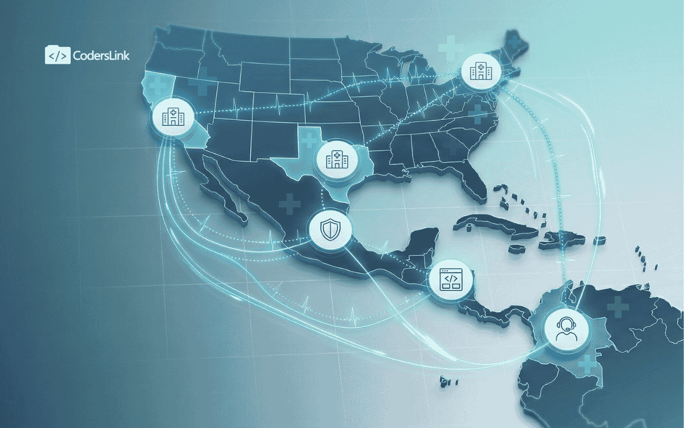
Nearshore healthcare IT staff augmentation is the specific model where the engineers come from Mexico or LATAM, working in CST or PST and overlapping fully with US business hours. CodersLink's Staff Augmentation service is the modern evolution of this model: long-term, dedicated engineers who behave as full extensions of your team, with no offshore communication lag and no entity setup overhead.
Why HealthTech leaders are turning to staff augmentation in 2026
The hiring math has stopped working domestically. The U.S. Bureau of Labor Statistics puts the median pay for computer and IT occupations at well over $100,000 per year, and senior healthcare engineering roles routinely clear $140,000 to $160,000 in major US metros. Hiring cycles for those roles run three to six months. The broader US tech sector still has more than a million unfilled positions, and HealthTech competes for the same talent as fintech and AI.
The pattern most HealthTech CTOs describe is consistent: a senior FHIR role opens in late winter, viable offers arrive in summer, one offer accepts and one ghosts onboarding, and a TEFCA or compliance deadline slips past the runway clock. The hiring engine is not just slow. It is incompatible with the calendar regulators and investors keep on engineering teams.
This is the gap healthcare IT staff augmentation fills. With CodersLink, the first shortlisted profiles arrive within 5 business days. Engineers are embedded in under 2 weeks. Per the CodersLink Tech Salaries Report 2026 (n=10,246), the median net monthly salary across all tech roles in Mexico is $3,139, with senior engineers earning $3,547. For a HealthTech CTO with a runway clock and a compliance clock running in parallel, that combination of speed and cost is the operational lever.
Want to see what a HealthTech squad would actually cost? Pull the role-level numbers from the CodersLink Tech Salaries Report before your next budget review.
The 5 healthcare IT roles best suited for augmentation
Not every role is the right fit. Augmentation works best for specialized roles where the search market is constrained and the work has a defined scope. Five roles consistently produce the strongest ROI in HealthTech engagements.
EHR and FHIR integration engineers: Epic and Cerner integration, HL7 v2 to FHIR R4 migrations and clinical data pipeline work. Most generalist engineers have not touched these systems. Augmentation lets you bring in someone who has, without a six-month domestic search.
HIPAA security and compliance engineers: Secure coding, role-based access control, audit log design and breach response readiness. These engineers must understand the regulatory frame before they touch your systems, not learn it on the job.
Telemedicine and mobile health developers: HIPAA-compliant iOS and Android applications, patient portal development and remote monitoring integrations. Mobile health is expanding faster than most internal teams can staff for.
Healthcare data and AI engineers: Clinical AI models, predictive analytics pipelines and PHI-safe data environments. Per the CodersLink Tech Salaries Report 2026, a Data Engineer in Mexico commands a median salary of $3,376 per month net (n=376, High confidence) and an AI Engineer commands $2,989 per month net (n=785, High confidence).
DevSecOps and cloud engineers: Continuous compliance validation, BAA-aligned infrastructure as code and HITRUST mapping. Per the CodersLink Tech Salaries Report 2026, a DevOps Engineer in Mexico commands a median salary of $3,772 per month net, and a Cybersecurity Engineer commands $2,997 per month net. The same report shows US-origin employers paying a +68.2% aggregate median premium over Mexico-origin employers ($4,431 vs $2,634, n=10,246), a gap that widens to +96% at the Principal level.
HIPAA compliance: what your vendor must deliver
HIPAA places direct obligations on any organization that brings external engineers into contact with protected health information (PHI). The 2013 HIPAA Omnibus Rule extended liability to contractors and made covered entities accountable for their compliance. If your augmented engineers can read, write or process PHI, you are accountable for their handling of the Privacy Rule, the Security Rule and the Breach Notification Rule.
The Business Associate Agreement (BAA) is the foundational document. Any vendor whose engineers will touch PHI must execute a BAA before work begins. CodersLink provides BAA-ready engagements as a standard part of HealthTech onboarding, not an add-on negotiated after the contract.
Beyond the BAA, your vendor's engineers should demonstrate:
- Compliance training history: documented HIPAA training completed before system access, with refresh cycles tracked.
- Access control protocols: minimum-necessary access, role-based permissions and no broad system privileges.
- NDA and data handling enforcement: confidentiality agreements specific to PHI environments.
- Audit readiness: the ability to produce access logs, vetting records and compliance evidence on demand.
- Incident response coverage: defined SLAs for breach notification, log preservation and forensic cooperation.
A vendor that cannot answer these questions in writing within 48 hours is not a HealthTech-ready partner. Treat the procurement conversation as an audit dry run.
Nearshore vs offshore: the cost is not the only number
Offshore augmentation, typically from India or Eastern Europe, opens an 8 to 12 hour timezone gap. For HealthTech systems with real-time data requirements, patient-facing uptime obligations and incidents that require an engineer on the call within an hour, that gap is an operational liability. Mexico operates in CST and PST, with zero to two hours of offset from US business hours.
Nearshore healthcare IT staff augmentation closes the gap without forcing the cost trade-off. Engineers attend your standups, respond to incidents in real time and pair-program during your sprint windows.
|
Role |
US median (annual, gross) |
Mexico nearshore (monthly, net) |
Annualized employer cost (Mexico, fully-loaded) |
|
Senior software engineer |
$140,000 to $160,000 |
$3,547 |
~$60,000 to $70,000 |
|
DevOps engineer |
$135,000 to $155,000 |
$3,772 |
~$64,000 to $75,000 |
|
Site reliability engineer |
$145,000 to $170,000 |
$4,029 |
~$68,000 to $80,000 |
|
Data engineer |
$135,000 to $155,000 |
$3,376 |
~$57,000 to $67,000 |
Mexico figures from the CodersLink Tech Salaries Report 2026 (n=10,246 verified responses, net employee take-home). Fully-loaded employer cost in Mexico typically runs 1.35 to 1.65x the net salary. US ranges from BLS data and major-metro market norms.
The difference compounds. A 5-person nearshore HealthTech squad typically delivers $400,000 or more in annual savings compared to US equivalents, with the same timezone and zero offshore communication lag. Reframed in roadmap terms: that is one extra mid-level engineer per year, or one quarter of additional runway, recovered without sacrificing seniority or compliance posture.
How to build your HIPAA-ready nearshore squad
Building a compliant nearshore engineering team is a structured process, not a sourcing exercise. The five steps below mirror how CodersLink runs HealthTech engagements end to end.
Step 1: Define your compliance scope
Identify which HIPAA rules apply to the engineering work: Privacy Rule, Security Rule, Breach Notification Rule. Determine whether engineers will access PHI directly or only PHI-adjacent infrastructure. This shapes your BAA requirements and the compliance experience level you need from candidates.
Step 2: Require BAA readiness from your vendor
Before any engineer touches your systems, your nearshore partner must execute a Business Associate Agreement. Verbal assurances do not satisfy the Omnibus Rule. CodersLink facilitates BAA execution as a standard part of HealthTech onboarding.
Step 3: Brief on stack, cadence and compliance history
Share your technical stack, sprint cadence, compliance posture and active audit timelines. CodersLink matches against a talent community vetted to the Top 1% Standard of Mexico's top engineers, with compliance experience tags applied during vetting so you only see relevant backgrounds.
Step 4: Review shortlisted profiles in 5 business days
Profiles include technical assessment scores, English proficiency ratings, HIPAA familiarity and background check results. You interview directly. CodersLink does not make placement decisions on your behalf.
Step 5: Onboard and integrate in under 2 weeks
The engineer joins standups, gains scoped repository access and completes your internal HIPAA onboarding before touching production systems. CodersLink holds the engineer's contract in Mexico, carries the classification decision and runs an engineer-care function: private medical, PTO, home-office allowance, equipment and performance coaching from day one.
For a deeper view of how CodersLink runs hub-style engagements where the goal is a long-term, transferable engineering team, the MESHubs service is the natural next step after an initial Staff Augmentation engagement matures.
Build the team your roadmap requires
Healthcare IT staff augmentation is not a workaround for a constrained domestic market. It is the right operational model for an environment where engineering talent is scarce, compliance requirements are non-negotiable and your roadmap cannot wait six months for a single domestic hire.
The nearshore model closes the cost gap without opening a timezone gap. HIPAA compliance is built in when you work with a partner that executes BAAs as standard practice, vets for compliance experience before presenting candidates and provides the documentation infrastructure your auditors will eventually request. The CodersLink Tech Salaries Report 2026 puts the all-roles median net monthly salary in Mexico at $3,139 (n=10,246), with senior engineers at $3,547. Those are the anchor numbers your CFO will want before signing the engagement.
For a broader view of how CodersLink structures employer engagements across services and verticals, browse the CodersLink blog for the comparison and salary deep-dives that complement this guide.
Hire with clarity. Scale with confidence. We Get IT Hired.
Key takeaways
Healthcare IT staff augmentation embeds external, pre-vetted engineers into your existing team to fill specialized gaps without adding permanent headcount.
The average US healthcare data breach cost reached $9.8 million in 2024, making vendor compliance posture a board-level concern, not just a procurement one.
Nearshore augmentation from Mexico delivers 40-60% cost reduction at every comparable seniority band, with full US business-hour coverage.
HIPAA puts the burden on you, not your vendor. The 2013 Omnibus Rule made covered entities accountable for contractor compliance.
CodersLink presents shortlisted profiles in 5 business days and embeds engineers in under 2 weeks.
FAQs
Healthcare IT staff augmentation is a staffing model where external, pre-vetted engineers with specialized HealthTech skills are embedded into your internal team to fill critical gaps without permanent hiring. Engineers work under your direction, inside your systems and to your sprint cadence, while the vendor handles payroll, benefits and compliance.
For HealthTech companies, the model is particularly valuable for roles requiring HIPAA experience, EHR or FHIR expertise and DevSecOps depth that the domestic market cannot supply on a useful timeline.
Augmented engineers must complete documented HIPAA training before accessing any system that handles PHI. Your vendor must execute a BAA. Under the 2013 HIPAA Omnibus Rule, you are responsible for your contractors' compliance, not just your direct employees, with breach liability flowing to the covered entity.
Require documented access controls, NDAs specific to PHI environments and audit-ready access logs. Ask your vendor to demonstrate prior BAA execution experience, not just HIPAA awareness slides.
Nearshore healthcare IT staff augmentation from Mexico typically costs 40-60% less than equivalent US hiring on a fully-loaded basis, with full US business-hour coverage. Per the CodersLink Tech Salaries Report 2026, the median net monthly salary for a senior engineer in Mexico is $3,547, against $140,000-$160,000 per year for US equivalents.
The cost reduction holds without a timezone penalty. Mexico-based engineers operate in CST and PST, sharing US business hours without the offset that makes offshore models difficult for healthcare operations. See the CodersLink case studies for HealthTech engagements with disclosed outcome metrics.
Related posts

What if the engineer you’re trying to hire barely exists?
Sep 30, 2026
•
9 min read
When a difficult search is telling you something A difficult technical requisition usually creates a predictable response. The role stays op…

Nearshore Hiring
IT outsourcing in Latin America: 2026 guide for US engineering leaders
Sep 22, 2026
•
12 min read
Most companies that outsource IT to Latin America aren't choosing a region. They're choosing how much control they're willing to give up, an…